South Africa has strong payment infrastructure but no single access layer
South Africa operates one of the most developed national payment systems on the African continent. Card penetration is strong, bank transfers are trusted by consumers, instant settlement rails are expanding, and crypto adoption is materially higher than in many peer markets.
For international PSPs, EMIs, marketplaces, trading platforms and exchanges, the challenge is not whether payment demand exists. The challenge is market access. Unlike PSD2 jurisdictions in Europe, South Africa does not offer a universal API gateway into domestic clearing. Participation is still built around bank relationships, settlement design, compliance positioning and carefully selected infrastructure partners.
That reality creates friction for new entrants, but it also creates opportunity. Platforms that structure local connectivity correctly from the start are usually better positioned to scale than those that treat South Africa as a simple card-acquiring market.
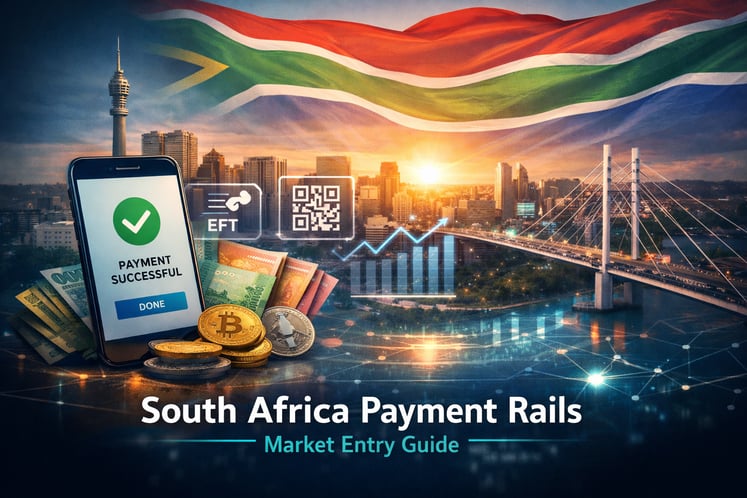 How the South African payment system is structured
At a high level, domestic clearing is coordinated by the South African Reserve Bank and processed operationally through BankservAfrica. Direct participation is generally limited to banks, which means most non-bank institutions connect through sponsored or mediated models.
In practice, market entry usually comes down to one of three routes:
- sponsor-bank connectivity for settlement access
- gateway or orchestration partners for merchant acceptance
- hybrid structures combining local banking, alternative rails and compliance overlays
This is why payment architecture in South Africa needs to be approached as a strategic exercise rather than a purely technical integration project.
EFT in South Africa remains the backbone of domestic settlement
Electronic Funds Transfer remains central to the South African market. It supports corporate treasury flows, supplier payments, payroll, lending disbursements and marketplace payouts. The term EFT, however, is often used too loosely. In local payments conversations, standard EFT and instant EFT are regularly discussed as if they were the same thing. They are not.
Standard EFT
Standard EFT is the traditional interbank transfer mechanism used across the banking system. It is cost-efficient, familiar to consumers and widely adopted by businesses. For many operating models, especially where immediate consumer confirmation is not essential, it remains a practical settlement rail.
The risk profile also differs from card payments. Standard EFT transactions do not sit inside the Visa or Mastercard chargeback framework. That means merchants are generally not exposed to scheme-driven consumer disputes, automated chargeback cycles or card-arbitration procedures.
That does not mean EFT is risk free. Reversals may still occur through fraud recovery actions, bank-initiated recall attempts, court orders or compliance interventions. The practical point is that this is an operational recall environment rather than a card-scheme dispute environment. For many merchants, that distinction is commercially significant.
Instant EFT
Instant EFT has become one of the most relevant checkout methods in South Africa’s digital economy. It is typically delivered through bank-authenticated payment flows that give the merchant immediate confirmation while using banking infrastructure rather than traditional card acquiring.
This matters for high-risk and high-frequency sectors. Exchanges, trading platforms, ticketing providers and marketplaces often favour instant EFT because it can combine strong customer authentication, real-time confirmation and lower acceptance costs than cards.
For foreign PSPs entering the market, instant EFT is no longer a niche local method. In many sectors it is a core acceptance rail.
PayShap is becoming South Africa’s strategic instant payment layer
PayShap is one of the most important structural developments in South African payments in recent years. The rail is designed for real-time low-value transfers and uses proxy identifiers such as mobile numbers rather than relying solely on bank account details.
The initial market narrative focused heavily on peer-to-peer transfers. That framing understates the long-term significance of the rail. The more important question is how PayShap will shape merchant acceptance, wallet funding, request-to-pay flows and mobile-native checkout experiences over time.
Banks are steadily expanding PayShap-enabled use cases, including:
For international operators, the strategic takeaway is clear. PayShap should not be viewed as a side rail. It should be treated as a developing infrastructure layer that may increasingly influence merchant expectations in South Africa.
In practical terms, PayShap is the closest local equivalent to what PIX became in Brazil and what UPI became in India: not just a payment feature, but a foundation for broader consumer and merchant behaviour change.
RTC still matters for settlement architecture
Real-Time Clearing remains important for urgent interbank transfers, treasury movements and institution-to-institution routing. It is not usually the headline consumer checkout method, but it still matters when settlement timing and liquidity management are central to the operating model.
Where payment businesses fail in South Africa, the issue is often not front-end acceptance. It is weak settlement design behind the scenes. RTC therefore remains relevant even when the commercial focus is on cards, instant EFT or PayShap.
DebiCheck supports authenticated recurring collections
Recurring payment businesses entering South Africa should pay close attention to DebiCheck. The rail is widely used by lenders, insurers and telecom providers because it allows customer authentication to happen directly within the banking environment.
That reduces dispute exposure materially when compared with older debit-order models and makes DebiCheck especially relevant for platforms with subscription or repayment flows.
Cards remain strong, but merchant stacks are broadening
Card acquiring remains a major part of the South African payments mix and will continue to matter across ecommerce and point of sale. That said, merchants are increasingly building multi-rail acceptance stacks rather than relying on cards alone.
The commercial logic is straightforward:
This is the same pattern seen in other maturing payment markets. Cards remain important, but they lose their status as the only serious option once instant and bank-native rails reach meaningful adoption.
South Africa is also a serious crypto market
Any credible review of South Africa payment rails should acknowledge the role of crypto in the local market. South Africa is one of the more mature African jurisdictions in terms of crypto participation, and it has already moved further than many peers in bringing crypto-related activity into a regulatory framework.
For exchanges and digital-asset businesses, the key issue is not only licensing. It is the ability to connect fiat onboarding and off-ramping into reliable banking infrastructure. That is where local rail strategy, sponsor-bank positioning and compliance alignment come together.
As a result, crypto in South Africa should not be analysed as a separate ecosystem. In practice, it intersects directly with payment rail strategy.
Comparison table: payment rail role and adoption in South Africa
|
Payment rail |
Settlement speed |
Primary role |
Dispute exposure |
Adoption trend |
|
Standard EFT |
Same day / next day |
Corporate and general bank transfer settlement |
Low |
Very high |
|
Instant EFT |
Immediate confirmation |
Digital checkout and real-time bank-authenticated acceptance |
Very low |
Very high growth |
|
PayShap |
Seconds |
Instant low-value transfers and emerging merchant use cases |
Very low |
Rapid expansion |
|
RTC |
Seconds |
Urgent bank-to-bank and treasury routing |
Low |
Moderate |
|
Cards |
Instant authorisation |
Core merchant acceptance across POS and ecommerce |
Medium |
Very high |
|
DebiCheck |
Scheduled |
Authenticated recurring collections |
Very low |
High |
Why foreign PSPs often misread the South African market
A common mistake is to treat South Africa as a standard acquiring market with a few local payment methods attached. That view misses the real structure of the ecosystem. Bank relationships still matter. Settlement design still matters. Rail mix still matters. Local trust dynamics still matter.
The strongest market-entry models usually combine several layers rather than depending on a single rail. That can include cards for broad acceptance, instant EFT for digital conversion, PayShap-readiness for future scale and banking arrangements that support fiat settlement for regulated or higher-risk activity.
How Obtained supports access to South Africa payment rails
Obtained supports PSPs, EMIs, exchanges, marketplaces and infrastructure providers entering regulated payment environments where local connectivity is not straightforward.
In South Africa, that typically means support with:
The objective is not simply to connect one payment method. It is to structure the right stack for the business model, sector risk and regional growth plan.
If you operate a unique payment rail in South Africa, collaboration matters
South Africa still offers meaningful room for collaboration across merchant settlement overlays, wallet infrastructure, crypto-fiat bridges, A2A orchestration and cross-border corridor solutions.
If your organisation operates a differentiated payment rail or infrastructure layer in South Africa and is open to strategic collaboration, Obtained welcomes discussions with operators looking to expand distribution, interoperability or international partner access.
Frequently asked questions
What is the most widely used payment rail in South Africa?
Cards and EFT remain the most established rails overall, while instant EFT is increasingly important for digital checkout and conversion.
Is PayShap the same as instant EFT?
No. Instant EFT generally refers to bank-authenticated merchant checkout flows, while PayShap is an instant payment rail designed for real-time low-value transfers and broader future use cases.
Can a foreign PSP connect directly to South Africa payment rails?
In most cases, no. Market access is usually structured through sponsor banks, local partners or gateway-led infrastructure models.
Why is crypto relevant to South Africa payment strategy?
Because fiat onboarding and off-ramping for exchanges and digital-asset businesses depends on reliable local banking and settlement connectivity.